How Much Concrete Do I Need for a Slab?
Turn slab length, width and thickness into ready-mix yards or bag counts, with enough allowance to finish the pour safely.
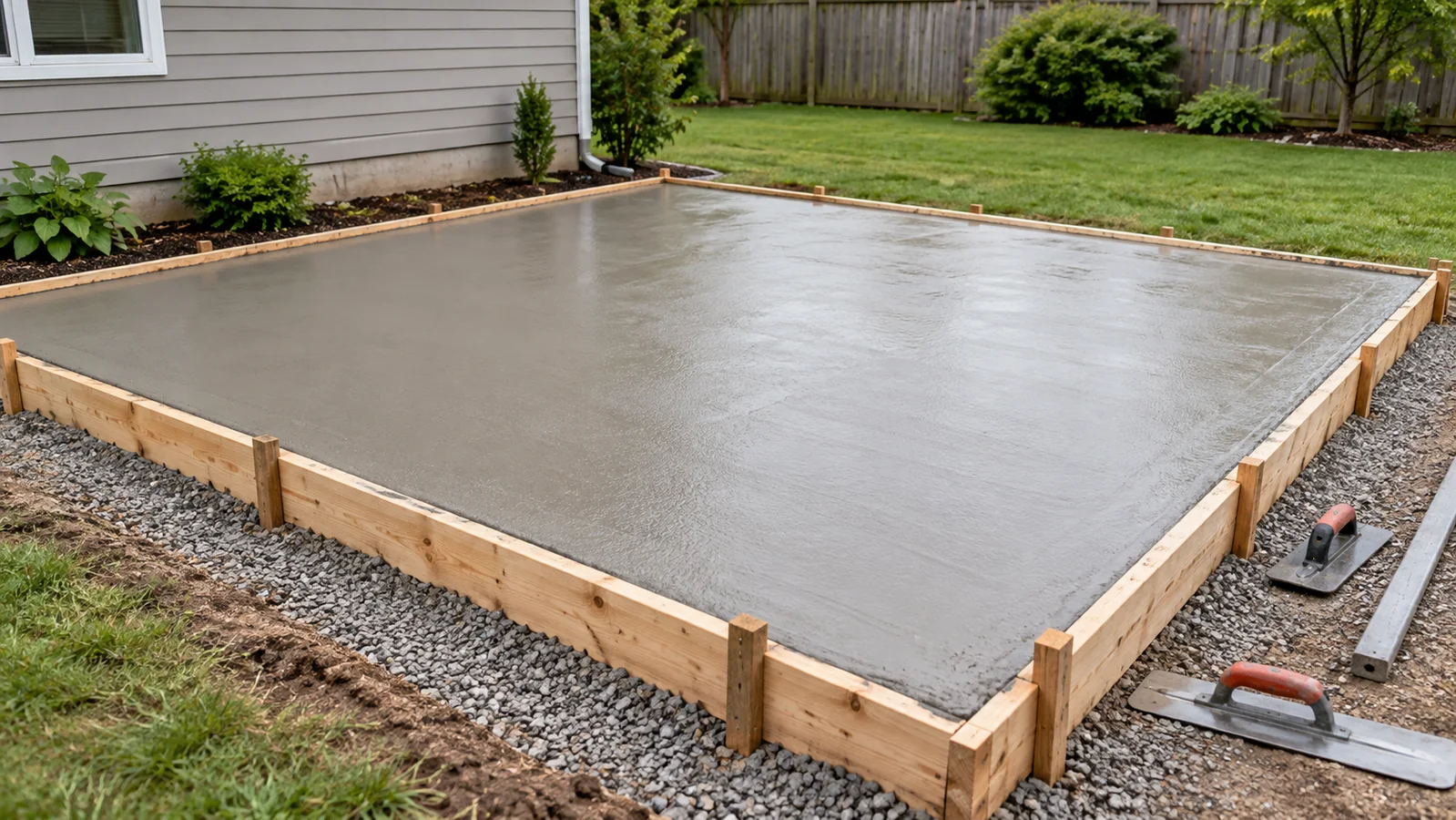
A 10 × 10 ft slab at 4 inches thick needs about 1.36 cubic yards of concrete after adding 10% for waste. In bagged mix, that is roughly 62 bags at 80 lb, 82 bags at 60 lb or 123 bags at 40 lb.
Concrete slab quantity chart
These estimates are for 4-inch slabs and include 10% extra. Structural requirements, thickened edges and uneven subgrade can increase volume.
| Slab size | Cubic yards + 10% | 80 lb bags | 60 lb bags |
|---|---|---|---|
| 8 × 8 ft | 0.87 yd³ | 40 | 53 |
| 10 × 10 ft | 1.36 yd³ | 62 | 82 |
| 12 × 12 ft | 1.96 yd³ | 88 | 118 |
| 10 × 20 ft | 2.72 yd³ | 123 | 163 |
Bag yields vary by manufacturer. Verify the yield printed on the mix you will buy and round up to whole bags.
The concrete slab formula
Cubic ft = length (ft) × width (ft) × thickness (in) ÷ 12
Cubic yd = cubic ft ÷ 27
Order volume = cubic yd × 1.10
For a 10 × 10 × 4-inch slab: 10 × 10 × 4 ÷ 12 = 33.33 cu ft. Divide by 27 for 1.23 yd³, then add 10% to reach 1.36 yd³.
Step 1: Measure inside the forms
- Measure the clear length and width inside the form boards.
- Check several points across the excavation for actual depth.
- Calculate thickened edges, grade beams or footings separately and add them.
- Confirm that forms are square, braced and set to the planned finished elevation.
An average slab only 1 inch thicker than planned uses 25% more concrete when the target was 4 inches. A properly graded and compacted base protects both the budget and slab performance.
Choose thickness for the load
- Patios and sidewalks: commonly 4 inches.
- Shed floors: commonly 4 inches when the base and loading permit.
- Driveways and garage slabs: often 5–6 inches with appropriate reinforcement.
- Heavy loads: require a design suited to soil, vehicle and local code conditions.
Thickness alone is not a structural design. Base preparation, reinforcement, joints, concrete strength and curing all affect performance.
Ready-mix or bags?
Bagged mix works well for small pads and repairs where a truck cannot reach. Mixing more than 60 heavy bags for a 10 × 10 slab requires substantial labor, water control and timing. Ready-mix often becomes more practical around one cubic yard, but short-load fees, access and local pricing matter.
Use the concrete calculator to compare ready-mix volume with 40, 60 and 80 lb bags. The 10 × 10 slab estimate and 12 × 12 slab estimate are ready to use.
Plan the pour before the truck arrives
- Provide a compacted, well-draining base at the correct elevation.
- Install reinforcement and maintain its specified position during placement.
- Prepare enough people, screeds and finishing tools for one continuous pour.
- Confirm truck access or arrange a pump, buggy or wheelbarrow route.
- Plan control joints at appropriate spacing and depth.
- Protect the slab from rapid moisture loss and follow the curing plan.
Common estimating mistakes
Forgetting the thickness conversion
Four inches is one-third of a foot. Multiplying by 4 instead of 4 ÷ 12 overstates the order by twelve times.
Ignoring low spots and thickened edges
The simple rectangle assumes uniform depth. Measure or calculate every extra section before ordering.
Ordering no allowance
A short load can create a cold joint while additional concrete is arranged. Ten percent is a common planning allowance, but the site may justify a different amount.
Frequently asked questions
How many 80 lb bags make one cubic yard?
At a typical yield of 0.60 cu ft per bag, one cubic yard takes about 45 bags. Always use the yield stated on your bag.
How thick should a patio slab be?
Four inches is common for residential patios on a properly prepared base, subject to soil, loading and local requirements.
How much extra concrete should I order?
Ten percent is a practical starting allowance for many small slabs. Complex forms, uncertain grade and pumping can change the appropriate buffer.
Does the gravel base count as concrete depth?
No. The compacted aggregate base sits below the slab. Measure concrete thickness from the top of the prepared base to the finished slab surface.