How Much Epoxy Do I Need for a Garage Floor?
Use the coverage formula, garage-size chart and preparation checklist to buy enough mixed epoxy without over-ordering.
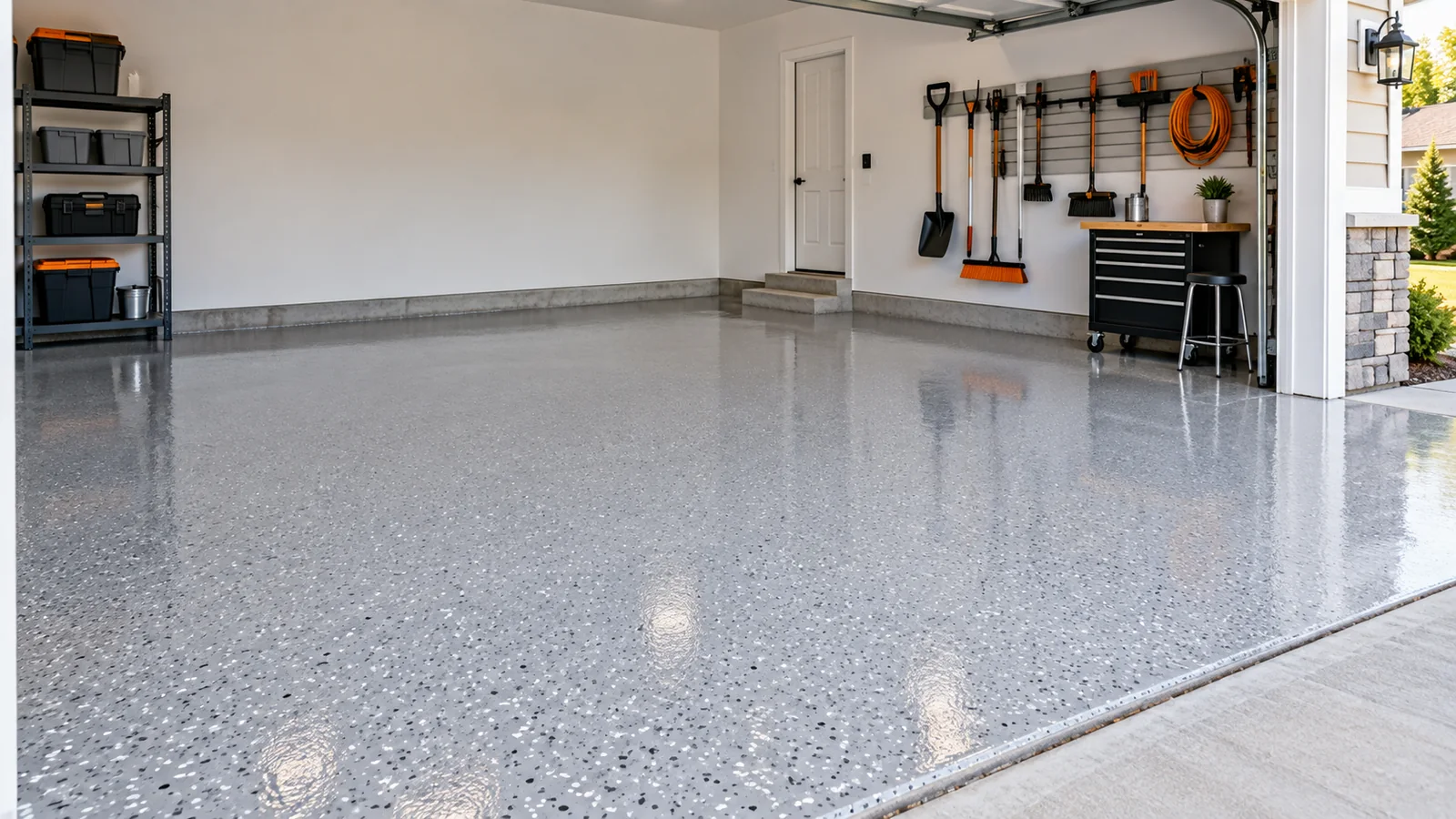
A typical 20 × 20 ft two-car garage needs about 2.75 gallons of mixed epoxy for one 10-mil coat after adding 10% for waste. The exact amount changes with floor area, coating thickness, concrete porosity and the number of coats in your system.
Garage floor epoxy coverage chart
The table below estimates total mixed epoxy for one 10-mil coat. It includes a 10% allowance for material left in the bucket, absorbed by the slab or lost around edges.
| Garage size | Floor area | Epoxy + 10% | Practical purchase |
|---|---|---|---|
| 12 × 24 ft (1 car) | 288 sq ft | 1.98 gal | At least 2 gal |
| 20 × 20 ft (2 car) | 400 sq ft | 2.74 gal | At least 3 gal |
| 22 × 22 ft (2 car) | 484 sq ft | 3.32 gal | At least 3.5–4 gal |
| 32 × 24 ft (3 car) | 768 sq ft | 5.27 gal | At least 5.5–6 gal |
These are geometry-based estimates, not a substitute for the product label. Broadcast flakes, rough concrete and high-solids products can change real coverage.
The formula behind the estimate
A coating is a very thin rectangular volume. Convert the floor to square inches, multiply by thickness in inches, then divide by 231—the number of cubic inches in one US gallon.
Gallons = floor area (sq ft) × 144 × thickness (in) ÷ 231
Gallons with waste = gallons × 1.10
For a 400 sq ft garage at 10 mils, use 0.010 inch as the thickness: 400 × 144 × 0.010 ÷ 231 = 2.49 gallons. Add 10% and the estimate becomes 2.74 gallons.
Step 1: Measure the usable floor area
- Measure wall to wall at the longest length and widest width.
- Multiply length by width to get square feet.
- Subtract permanent areas you will not coat, such as a fixed cabinet footprint.
- Measure alcoves or separate storage bays as rectangles and add them back.
Do not estimate from “one-car” or “two-car” labels alone. Two garages with the same number of doors can differ by more than 100 sq ft.
Step 2: Choose thickness and count every coat
“Epoxy floor” can describe several different systems. A thin primer, pigmented base coat and clear topcoat each have their own coverage rate. Calculate each product separately rather than treating the system as one bucket.
- One 10-mil coat: about 160 sq ft per theoretical gallon.
- One 20-mil coat: about 80 sq ft per theoretical gallon.
- Two equal coats: roughly double the total volume.
- Flake floors: follow the basecoat and clearcoat coverage on their separate labels.
Step 3: Account for the condition of the concrete
A smooth, previously sealed slab uses material differently from porous or mechanically profiled concrete. Cracks, control joints and spalled patches also consume coating. Keep the 10% buffer, and consider a little more when the slab is unusually rough.
Surface preparation determines whether the coating bonds. Clean off oil, repair defects and profile the slab using the method required by the coating manufacturer. Perform the recommended moisture test before coating; trapped moisture can cause bubbling or delamination.
How much does garage floor epoxy cost?
Material cost equals the gallons you need multiplied by the mixed-kit price per gallon. If a 20 × 20 ft floor needs 2.74 gallons and the mixed product costs $60 per gallon, the coating estimate is about $165 before primer, topcoat, flakes, repair materials and tools.
Use the epoxy calculator to change the dimensions, thickness, waste allowance and price. For common sizes, open the 20 × 20 ft two-car garage estimate or the 32 × 24 ft three-car garage estimate.
Buying checklist
- Confirm whether the label lists mixed gallons or separate resin and hardener volumes.
- Check coverage at your intended thickness—not just the largest coverage number on the box.
- Buy compatible primer, basecoat and topcoat from the same approved system.
- Check pot life and divide the floor into batches you can roll before the material thickens.
- Read the safety data sheet and use the required ventilation and protective equipment.
Common estimating mistakes
Using kit count instead of mixed volume
A “two-part kit” may contain one total mixed gallon, not two gallons. Add the stated resin and hardener volumes only when the label presents them separately.
Ignoring the second coat
If the specification calls for two coats, calculate both. The second coat may have a different coverage rate from the first.
Buying exactly the theoretical amount
Stopping mid-floor can leave a visible edge. A reasonable buffer is cheaper than rushing to find a matching batch after the pour has started.
Frequently asked questions
How many gallons of epoxy for a two-car garage?
A 20 × 20 ft garage needs about 2.75 mixed gallons for one 10-mil coat with 10% waste. Larger 22 × 22 ft garages need about 3.32 gallons at the same thickness.
How many square feet does one gallon of epoxy cover?
The theoretical coverage is about 160 sq ft at 10 mils or 80 sq ft at 20 mils. The product label may specify less coverage because it accounts for formulation, surface texture and application conditions.
Do I include the clear topcoat?
Yes, but calculate it separately using the topcoat label. A clear polyurethane or polyaspartic topcoat can have a different solids content and coverage rate from the epoxy basecoat.
Should I buy extra epoxy?
A 10% allowance is a practical starting point. Rough or porous slabs may justify more, while a manufacturer-rated kit already designed for your exact floor size may include its own allowance.