How Much Paver Base Do I Need for a Patio?
Size the compacted gravel base, bedding sand and paver order together so the patio stays level and drains correctly.
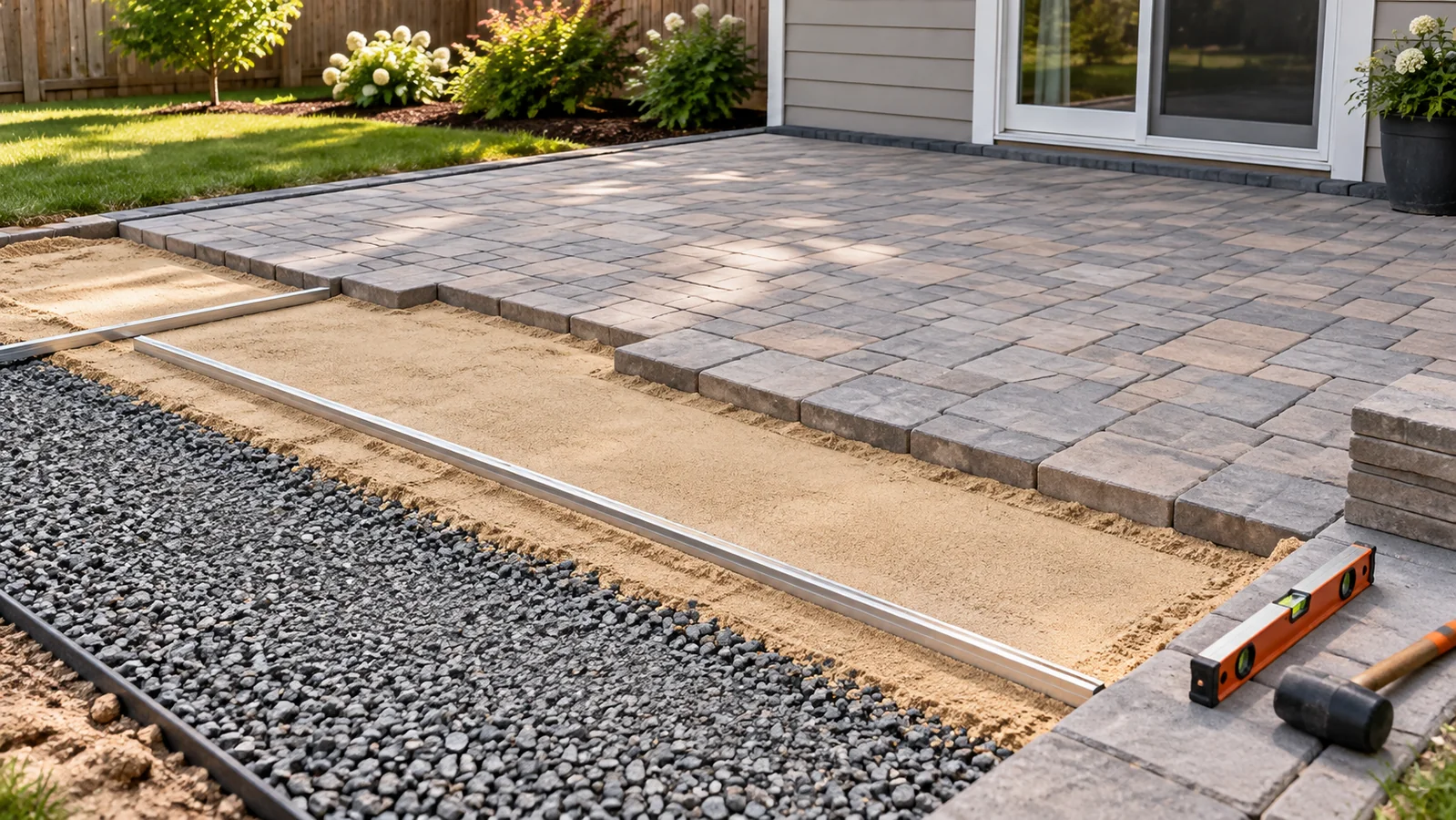
A 12 × 12 ft patio with a 4-inch compacted base needs 48 cubic feet of paver base. That is about 1.78 cubic yards, or 96 half-cubic-foot bags, before allowing for compaction and the base extension beyond the paver edge.
Paver base quantity chart
The chart uses the finished paver area and a 4-inch base. Real excavation should extend the base about 6 inches beyond the pavers on every side to support edge restraint.
| Patio size | Area | Base volume | 0.5 cu ft bags |
|---|---|---|---|
| 10 × 10 ft | 100 sq ft | 33.3 cu ft | 67 |
| 12 × 12 ft | 144 sq ft | 48 cu ft | 96 |
| 12 × 16 ft | 192 sq ft | 64 cu ft | 128 |
| 16 × 20 ft | 320 sq ft | 106.7 cu ft | 214 |
Bag counts show why bulk aggregate is normally more practical for patios. Ask the supplier whether quoted volume is loose or compacted and include the extended base footprint.
The base-volume formula
Base cubic ft = length × width × depth (in) ÷ 12
Base cubic yd = cubic ft ÷ 27
Bag count = cubic ft ÷ bag yield
For a 12 × 12 patio: 12 × 12 × 4 ÷ 12 = 48 cu ft. Divide by 27 for 1.78 yd³. If each bag yields 0.5 cu ft, the theoretical count is 96 bags.
How deep should a paver base be?
- Patios and walkways: often 4 inches of compacted base on stable soil.
- Weak, wet or clay soil: may require additional excavation and a thicker engineered section.
- Driveways: commonly require 6–8 inches or a locally engineered depth for vehicle loads.
- Freeze-thaw climates: local conditions and code can require deeper, well-draining base.
Depth means compacted thickness—not the loose thickness immediately after dumping. Place aggregate in roughly 2-inch lifts and compact each lift before adding the next.
Do not forget the extended base area
A durable installation carries compacted aggregate beyond the visible paver edge. For a 12 × 12 ft patio with a 6-inch extension on all sides, the base footprint is roughly 13 × 13 ft, not 12 × 12. That increases a 4-inch base from 48 to about 56.3 cu ft.
Leveling sand is a separate layer
After compaction, screed about 1 inch of suitable bedding sand over the base. Do not use extra sand to correct a poorly graded base. At 1 inch, a 12 × 12 patio needs 12 cu ft of bedding sand. Screed only the area you can cover without walking on it.
Estimate pavers and polymeric sand together
A 12 × 12 patio using 12 × 12 inch pavers needs 144 pavers by area, or about 152 after adding 5% for cuts and breakage. Joint-sand coverage changes with paver size, joint width and depth, so use the manufacturer label for the final order.
Use the paver base calculator for pavers, base bags, leveling sand and polymeric sand together. Open the 12 × 12 patio estimate or the 3 × 30 walkway estimate as a starting point.
Installation checklist
- Mark utilities and confirm finished elevation and drainage direction.
- Excavate for compacted base, 1-inch bedding layer and paver thickness.
- Compact the subgrade and install separation geotextile where the design calls for it.
- Place and compact base in lifts, checking slope as you work.
- Screed bedding sand, lay pavers and install edge restraint.
- Compact the pavers as specified, fill joints and activate polymeric sand exactly as labeled.
Frequently asked questions
How many bags of paver base per square foot?
At 4 inches deep, one square foot uses 0.333 cu ft. A 0.5 cu ft bag theoretically covers about 1.5 sq ft before compaction allowance.
Can I put pavers directly on dirt?
Direct-to-soil installations commonly settle, rock and lose alignment. A compacted aggregate base distributes loads and manages movement.
Is paver base the same as pea gravel?
No. Paver base is normally an angular, well-graded aggregate that compacts. Rounded pea gravel moves under load and is not a substitute.
How much slope does a patio need?
A common target is about 1/8 inch per foot away from the house, subject to the site plan and local drainage requirements.